 Seminole Siding
 Why Deck Repair Looks Different on Belleair Beach
Belleair Beach sits on a narrow barrier island in Pinellas County, with the Gulf of Mexico on one side and Clearwater Harbor and the Intracoastal Waterway on the other. That geography means a deck out here rarely gets a break from salt air, whichever direction the wind is blowing from, and it takes direct, near year-round UV with little tree canopy to soften it. Add hurricane-force wind loads that are a real design consideration several months of the year, and you get a structure that ages faster and less predictably than a similar deck built a few miles inland.
Many homes on this stretch of coastline are elevated on pilings, which changes how a deck's substructure interacts with the elements — it's not tucked close to grade the way an inland deck often is, it's exposed to wind and moisture moving underneath it from multiple directions. A board that looks a little gray, a railing that flexes slightly, or a faint squeak underfoot can be nothing, or it can be the visible edge of a problem that's already well underway beneath the surface. The only way to know is to actually look, which is what a correct repair estimate starts with.
This page covers what typically goes wrong with decks on Belleair Beach, how we sort cosmetic wear from structural problems, what a repair done right actually involves, and why hiring a crew that already works this island — rather than one encountering these conditions for the first time on your project — changes the outcome.
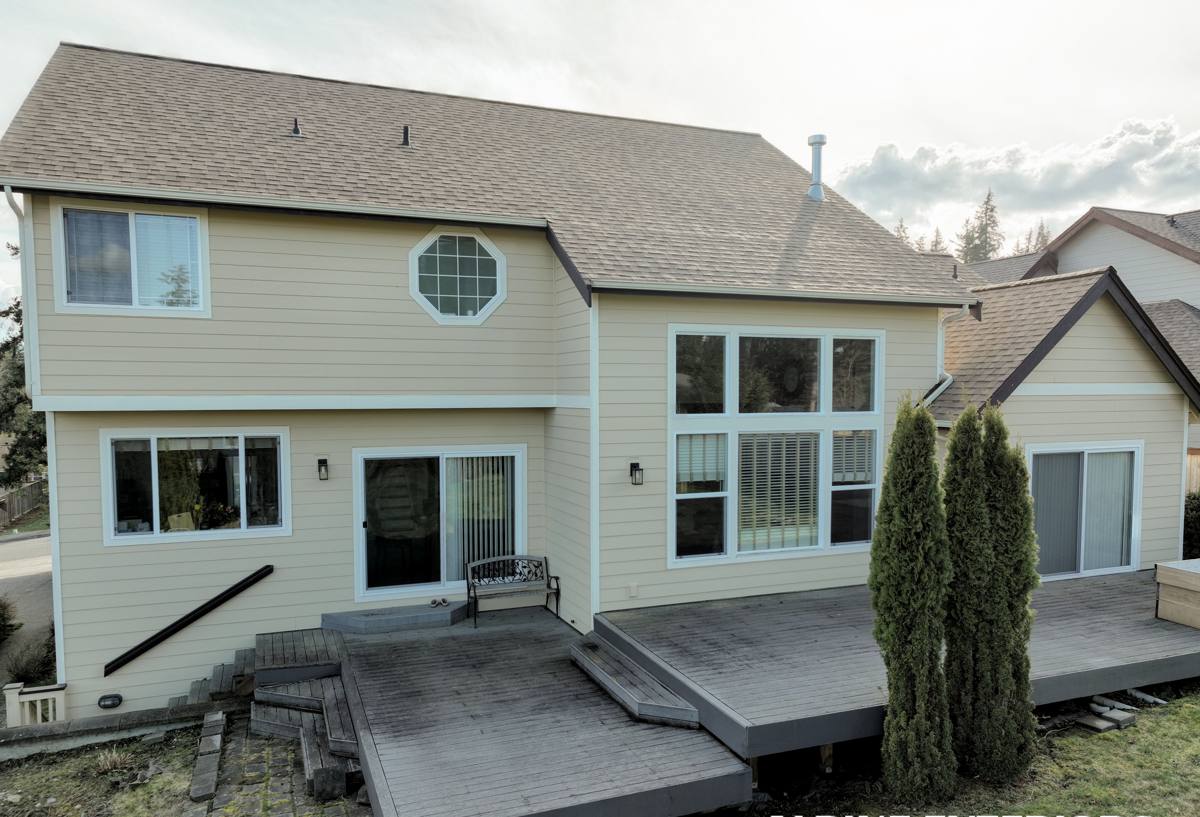
What Salt Air, Sun, and Storms Do to a Deck Out Here
Salt Air From Two Directions
On a barrier island this narrow, salt-laden air isn't limited to one exposure — Gulf breeze and harbor-side air both settle on a deck's surface and hardware continuously, not just when a storm is moving through. That accelerates corrosion in fasteners, joist hangers, and railing hardware well before any of it is visible from above. A board that's started to lift slightly at one end, or a railing post with a bit more give than it should have, is often the first outward sign of hardware that's already lost real holding strength underneath.
Relentless UV
Florida gets some of the highest cumulative UV exposure in the country, and a deck surface takes that head-on for most of the day, most of the year, with no wall or roof overhang to interrupt it. On wood decking, that breaks down surface fibers and finishes, leading to graying, splitting, and checking well ahead of the material's actual structural life. On composite or PVC decking, sustained UV can fade color and, on older or lower-grade boards, degrade the surface layer over time. On its own, sun damage tends to be cosmetic. Left alone, it opens the door for moisture to get into material it was previously protecting.
Wind-Driven Rain and Hurricane-Force Gusts
Hurricane-force wind is a real design condition for a Belleair Beach deck, and it does more than test the structure during a named storm. Wind-driven rain gets forced sideways and upward into gaps, joints, and fastener penetrations that ordinary vertical rain would never reach, pushing moisture into framing and connection points that are otherwise reasonably protected. After a rough storm season, it's common to find popped fasteners, a slightly shifted ledger connection, or railing posts that have loosened, even on a deck that looks fine from a quick glance.
Elevated Construction and Substructure Exposure
Because so many homes here are built up on pilings, a deck's substructure often sits more fully exposed to wind, salt spray, and humidity than it would on a slab-level property. That framing is doing all of the structural work the surface boards depend on, and on an elevated barrier island home, it's typically taking in weather from underneath as well as above. Moisture or corrosion damage at this level is, in our experience, the most serious issue we find on these decks, and it's usually further along than what shows on the surface — because it starts in the framing before it ever reaches the boards you walk on.
Cosmetic Wear vs. Structural Problems
Not every issue on an aging deck calls for the same response, and telling the two apart correctly is the actual job of a proper repair estimate — not an afterthought to it.
| Symptom | Usually Cosmetic | Often Structural |
|---|---|---|
| Grayed or faded surface, wood or composite | Yes — sun and weathering | Only if boards are also soft or splitting through |
| Squeaking or slight bounce underfoot | Sometimes — loose deck-board fasteners | Often — loosened joists or hangers |
| Railing that flexes or wiggles | Rarely | Usually — loose posts or corroded hardware |
| Soft or spongy spot in decking | No | Yes — rot or moisture damage below the surface |
| Rust staining around fastener heads | Cosmetic if isolated | Can signal hardware failure underneath |
| Movement or gap where deck meets house | No | Yes — ledger connection needs prompt attention |
Cosmetic issues affect appearance and can generally wait for a normal maintenance cycle. Structural issues affect the deck's ability to safely carry weight, and shouldn't be deferred — particularly anything touching the ledger connection, joist hangers, or support posts.
How We Diagnose a Deck Before Recommending Repair
A repair estimate that's actually worth something starts with a real inspection, not a walk-by. On a Belleair Beach deck, that typically includes:
- Checking the ledger board connection to the house, since it's the most common serious failure point and the hardest one to catch from a casual look
- Probing boards and framing members for soft spots that indicate rot or moisture intrusion, rather than relying on appearance alone
- Inspecting joist hangers, fasteners, and railing hardware for corrosion, especially on decks that face open water on more than one side
- Checking support posts and footings for movement, settling, or standing water contact underneath the structure
- Assessing railing height, spacing, and attachment for code compliance, particularly on elevated decks where a failure has real fall consequences
- Evaluating drainage and airflow underneath and around the deck, since poor ventilation there accelerates nearly every other problem on this list
We walk through what we actually find — what needs attention now, what can reasonably be monitored, and what's purely cosmetic — before recommending any scope of work.
Repair or Replace: How We Actually Make That Call
Homeowners often assume any visible deck problem means a full rebuild, or swing the other way and assume a repair will always be cheaper and just as good. Neither assumption holds up consistently once you look at the specific factors involved.
| Cost Factor | Tends Toward Repair | Tends Toward Replacement |
|---|---|---|
| Extent of substructure damage | Isolated rot or corrosion at a few joists or hangers | Widespread moisture damage through the framing |
| Age of the structure | Mid-life deck with sound framing overall | Deck near the end of its practical service life |
| Original build quality | Framed and fastened to current wind and coastal standards | Built to older standards that don't hold up to current exposure |
| Surface vs. structure condition | Sound framing, worn or faded surface boards only | Structure and surface both compromised |
| Scope of hardware replacement needed | A handful of fasteners, hangers, or connectors | Nearly all hardware needs upgrading to hold up going forward |
We'll give a straight answer on which side of that line a given deck falls on, including telling you when replacement is genuinely the more sensible path — not defaulting to whichever job happens to be larger.
What a Correct Repair Involves
Matching Materials to What's Already There
Repairing a deck means working with the existing structure and, in most cases, the existing surface material — wood, composite, or PVC. Matching board profile, fastening method, and, where possible, color and finish is what keeps a repair from reading as an obvious patch. On composite and PVC decking especially, discontinued colors or profiles can make an exact match difficult, and we'll say so up front rather than after the work has started.
Upgrading Hardware, Not Just Swapping It
When we replace corroded fasteners, hangers, or connectors, we use stainless steel or coastal-rated hardware suited to this level of salt exposure — not a like-for-like swap with standard-grade hardware that will corrode again on roughly the same timeline. This single decision is one of the biggest factors in whether a repair holds up for years or needs redoing sooner than it should have.
Fixing the Cause, Not Just the Symptom
A soft board is a symptom. Standing water underneath, poor drainage, or a failed flashing detail at the ledger is usually the actual cause. A repair that swaps out visible damage without correcting whatever caused it tends to fail again in the same spot — often faster the second time, because the underlying issue was never addressed.
Structural Repairs Get Held to New-Construction Standards
Ledger connections, joist hangers, and support posts are load-bearing, full stop. Repairs to those elements are done to the same standard as new construction — correct fastener grade, correct flashing detail, and connections sized for local wind load requirements — not treated as a lesser scope simply because it's a repair rather than a ground-up build.
Permitting and Flood Zone Considerations on a Barrier Island
Belleair Beach, like most of this stretch of coastline, involves flood zone and elevation considerations that don't apply the same way to an inland Pinellas County property. Depending on the scope of work, a deck repair or rebuild here can trigger permitting review tied to elevation, setback from the water, or the percentage of the existing structure being replaced. This is one of the more overlooked parts of deck work on a barrier island — a homeowner focused on the boards and railings can be caught off guard by a permitting requirement that has nothing to do with the visible repair itself.
We pull permits as part of the job and handle that review process rather than leaving it for the homeowner to sort out mid-project. Knowing in advance whether a given scope crosses into replacement-level permitting, versus a straightforward repair that doesn't, is part of giving an estimate that doesn't change shape once the work is underway.
Maintenance That Extends a Repair's Lifespan
- Rinse the deck surface periodically to clear salt residue and organic buildup before it works into the material
- Keep gaps between boards clear of debris so water and airflow move through the way the deck was designed to shed them
- Check railing posts and exposed hardware a couple of times a year for early corrosion or looseness, especially right after hurricane season
- Trim back landscaping that traps moisture against the deck's edge or blocks airflow underneath an elevated structure
- Address any soft spot or new movement right away rather than waiting for the next scheduled look — these are structural signs, not cosmetic ones
- Reseal or refinish wood decking on a schedule suited to this climate, since sun exposure here shortens the useful interval compared to inland decks
Why It Matters That We Already Work Belleair Beach
A crew that mainly repairs decks inland can still turn out competent work here, but a barrier island repair involves variables that come up more often on this kind of property than elsewhere in Pinellas County — corrosion patterns driven by salt exposure from two directions, wind load requirements tied to open-water exposure, and permitting that can involve flood zone and elevation review depending on the scope. We're based nearby in Seminole and already work this stretch of coastline regularly, so we're not guessing at those requirements or learning them mid-project. We know what fastener grade actually holds up out here, what a ledger connection needs to survive a real storm season, and how permitting works locally for a repair versus a larger rebuild, because we've handled it on decks like yours.
That familiarity also produces a more accurate first estimate, with less back-and-forth once work is underway, because the inspection already accounts for how this specific environment behaves instead of applying a generic inland checklist to a barrier island property.
Get an Honest Look at Your Deck
Whether you're dealing with one specific issue — a soft spot, a loose railing, damage after a storm — or you just want a straight read on where your deck currently stands, we're glad to walk the property and explain what we find plainly, including when the honest answer is that it doesn't need much yet. Reach out below for a free, no-pressure estimate.